

Are Arboreal Foliovores Of The Australian Template Forests

Elephants are an example of a mammalian folivore.
In zoology, a folivore is a herbivore that specializes in eating leaves. Mature leaves contain a high proportion of hard-to-digest cellulose, less free energy than other types of foods, and often toxic compounds.[ane] For this reason, folivorous animals tend to accept long digestive tracts and slow metabolisms. Many enlist the help of symbiotic bacteria to release the nutrients in their diet. Additionally, as has been observed in folivorous primates, they exhibit a stiff preference for immature leaves, which tend to exist easier to masticate, tend to be higher in energy and protein, and lower in fibre and poisons than more than mature fibrous leaves.[1]
Evolution [edit]
Herbivory has evolved several times amongst unlike groups of animals. The first vertebrates were small fish that consumed protists and invertebrates. After these fish, the next group of vertebrates to evolve were piscivores, then insectivores, carnivores and finally herbivores.[2] Since a complex ready of adaptations was necessary for feeding on highly fibrous plant materials (structural modifications to the teeth, jaws, and digestive tract) and only a small proportion of extant tetrapods are obligate herbivores, it could exist that early tetrapods fabricated the transition to fully fledged herbivory by way of omnivory.[2]
Folivory and flight [edit]
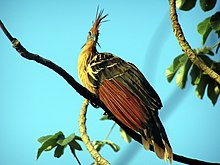
It has been observed that folivory is extremely rare among flying vertebrates.[iii] Morton (1978) attributed this to the fact that leaves are heavy, slow to digest, and contain picayune energy relative to other foods.[3] The hoatzin is an case of a flighted, folivorous bird. At that place are, notwithstanding, many species of folivorous flying insects.
Some bats are partially folivorous; their method of deriving nourishment from leaves, according to Lowry (1989), is to chew upwardly the leaves, swallowing the sap and spitting out the remainder.[4]
Arboreal folivores [edit]

Arboreal mammalian folivores, such as sloths, koalas, and some species of monkeys and lemurs, tend to be large and climb cautiously.[5] Similarities in body shape and caput- and molar-structure between early hominoids and various families of arboreal folivores have been avant-garde as show that early on hominoids were also folivorous.[five]
Primates [edit]
Standard ecological theory predicts relatively large group sizes for folivorous primates, as large groups offer better collective defense against predators and they confront little competition for nutrient among each other. It has been observed that these animals nevertheless frequently live in pocket-size groups. Explanations offered for this apparent paradox include social factors such as increased incidence of infanticide in big groups.[six]

Folivorous primates are relatively rare in the New World, the primary exception beingness howler monkeys. Ane explanation that has been offered is that fruiting and leafing occur simultaneously amid New World plants. However a 2001 study found no bear witness for simultaneous fruiting and leafing at most sites, manifestly disproving this hypothesis.[7]
Examples [edit]
Examples of folivorous animals include:
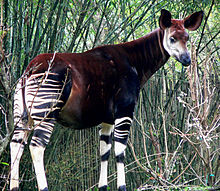
- Mammals: okapis, elephants, sloths, possums, behemothic pandas, koalas and various species of monkey, i.e. New World howlers and Old Earth colobines
- Birds: The hoatzin of the Amazon region and the kakapo of New Zealand
- Reptiles: iguanas[8]
- Insects: various kinds of caterpillars, sawflies, beetles, leaf miners and Orthoptera
- Others: many land gastropod species (snails and slugs)
See also [edit]
- Consumer-resources systems
- Leafage miner, the folivorous strategy of many insects
References [edit]
- ^ a b Jones, S., Martin, R., & Pilbeam, D. (1994) The Cambridge Encyclopedia of Homo Evolution. Cambridge: Cambridge University Press
- ^ a b Sahney, S., Benton, M.J. & Falcon-Lang, H.J. (2010). "Rainforest collapse triggered Pennsylvanian tetrapod diversification in Euramerica". Geology. 38 (12): 1079–1082. doi:x.1130/G31182.1.
{{cite journal}}: CS1 maint: multiple names: authors list (link) - ^ a b Do the Ability Requirements of Flapping Flight Constrain Folivory in Flight Animals? R. Dudley, 1000. J. Vermeij Functional Ecology, Vol. 6, No. 1 (1992), pp. 101-104
- ^ Folivory in Bats: An Adaptation Derived from Frugivory by T. H. Kunz and K. A. Ingalls; Functional Environmental, Vol. 8, No. 5 (Oct., 1994), pp. 665-668
- ^ a b Cautious climbing and folivory: a model of hominoid differentation E. East. Sarmiento1 in Human Evolution Volume ten, Number 4, August, 1995
- ^ Competition and group size in Thomas's langurs (Presbytis thomasi): the folivore paradox revisited R. Steenbeek and Carel P. van Schaik: Behavioral Ecology and Sociobiology Book 49, Numbers 2-three / Jan, 2001; Print ISSN 0340-5443; Online ISSN 1432-0762
- ^ Heymann, Eckhard W. (2001). "Tin phenology explain the scarcity of folivory in New Globe primates?". American Journal of Primatology. 55 (3): 171–175. doi:10.1002/ajp.1050. ISSN 1098-2345. PMID 11746280. S2CID 8344876.
- ^ "The Diet of a Generalized Folivore: Iguana iguana in Panama".
External links [edit]
 | Look up folivore in Wiktionary, the gratuitous lexicon. |
- wordquests.info

Are Arboreal Foliovores Of The Australian Template Forests,
Source: https://en.wikipedia.org/wiki/Folivore
Posted by: cartercamestich1950.blogspot.com
0 Response to "Are Arboreal Foliovores Of The Australian Template Forests"
Post a Comment